Product Description
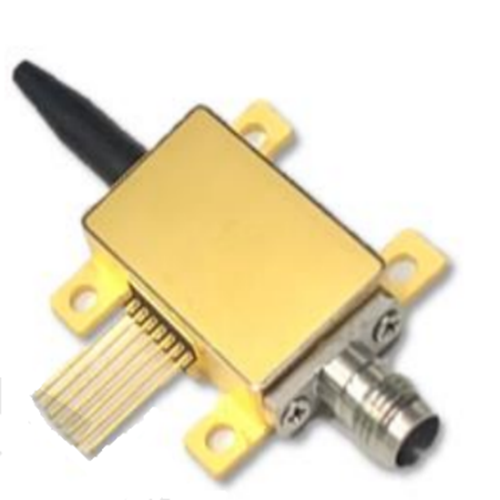
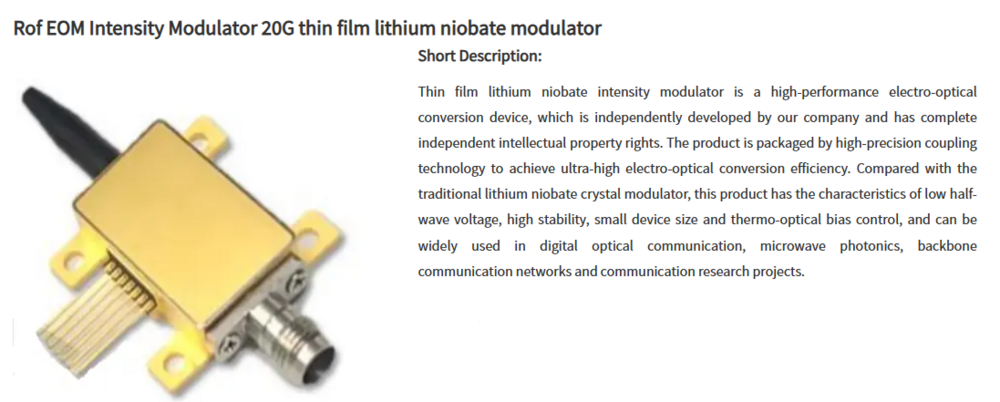
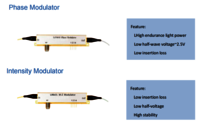
Rof 20G TFLN modulator. Thin film lithium niobate intensity modulator is a high-performance electro-optical conversion device, which is independently developed by our company and has complete independent intellectual property rights. The product is packaged by high-precision coupling technology to achieve ultra-high electro-optical conversion efficiency. Compared with the traditional lithium niobate crystal modulator, this product has the characteristics of low half-wave voltage, high stability, small device size and thermo-optical bias control, and can be widely used in digital optical communication, microwave photonics, backbone communication networks and communication research projects.
|
Category
|
Argument
|
Sym |
Uni |
Aointer |
|
Optical performance
(@25C)
|
Operating wavelength (*) |
I |
nm |
X2i14C |
| 1550 |
| Optical extinction ratio (@DC) () |
ER |
dB |
20 |
|
Optical return loss
|
ORL |
dB |
-27 |
|
Optical insertion loss (*)
|
IL |
dB |
MAX: 5.5Typ: 4.5 |
|
Electrical properties (@25C)
|
3 dB electro-optical bandwidth (from 2 GHz
|
S21 |
GHz |
X1: 2 |
X1: 4 |
| MIN: 18Typ: 20 |
MIN: 36Typ: 40 |
|
Rf half wave voltage (@50 kHz)
|
VI |
V |
X3i145 |
X3i146 |
| MAX: 3.0Typ: 2.5 |
MAX: 3.5Typ: 3.0 |
| Heat modulated bias half wave power |
PI |
mW |
50 |
|
Rf return loss (2 GHz to 40 GHz)
|
S11 |
dB |
-10 |
|
Working condition
|
Operating temperature
|
TO |
C |
-2070 |
High-Speed Modulation PerformanceEngineered with thin film lithium niobate (TFLN) technology, this modulator delivers an impressive 20 GHz electro-optic bandwidth and rise/fall times under 20 ps. Such attributes make it a powerful solution for next-generation optical communication and quantum photonics, supporting high data rates and precise signal control.
Reliable and Efficient DesignWith insertion loss below 4 dB and a typical extinction ratio greater than 20 dB, the modulator ensures minimal power loss and robust signal quality. Fully compatible with polarization maintaining (PM) fibers, and featuring standard FC/APC or custom connectors, installation and integration are both simple and adaptable.
Flexible Integration and User SupportThis TFLN modulator is designed for easy PCB mounting and optical bench compatibility, allowing seamless inclusion into diverse research or commercial environments. Comprehensive accessories, including a user manual and mounting kit, ensure smooth setup, while standard ESD protection safeguards sensitive components.
FAQ's of Rof Intensity Modulator thin film lithium niobate modulator 20G TFLN modulator:
Q: How do I install the Rof Intensity Modulator in my optical system?
A: The modulator comes with a mounting kit and user manual for straightforward installation. Its compact dimensions (32 mm x 12 mm x 4 mm) and PCB mounting compatibility allow easy integration into existing setups. Simply connect the polarization maintaining (PM) fiber pigtails and ensure the external DC power supply is set to 3.3 V or 5 V as required.
Q: What are the main benefits of using this TFLN modulator in high-speed networks?
A: This modulator offers a 20 GHz electro-optic bandwidth, low V (<4 V), and rise/fall times under 20 ps. These features enable precise, high-speed intensity modulation needed for advanced optical communications, 5G networks, data centers, and quantum photonics. The high extinction ratio (>20 dB) and low insertion loss enhance signal quality and minimize power consumption.
Q: When should I choose the Rof Intensity Modulator for my application?
A: Select this modulator when your application requires reliable, high-speed modulation (up to 20 GHz) with precise control and minimal signal degradation. It is ideal for modern data centers, quantum photonic experiments, optical communication infrastructure, and future-ready 5G networks.
Q: Where can I use this modulator considering environmental requirements?
A: This device operates efficiently within a temperature range of 0C to 70C and supports humidity up to 85% RH (non-condensing), making it suitable for various lab environments and commercial installations. Its robust design ensures consistent performance under typical operating conditions.
Q: What is the process for connecting this modulator to my system's fiber optics?
A: The modulator uses PM fiber pigtails with FC/APC or custom connectors. Simply match the connectors to your system's interface, ensure secure connections to maintain polarization, and follow the provided guidelines in the user manual for optimal setup and signal integrity.
Q: How does the modulator maintain signal quality during operation?
A: A high extinction ratio (>20 dB), low chirp parameter (near zero), and return loss over 45 dB help maintain signal clarity and reduce unwanted reflections or distortions. The thin film lithium niobate substrate and advanced fabrication process further ensure efficient, stable modulation.
Q: What applications benefit most from this intensity modulator?
A: The device is particularly beneficial for optical communication networks, 5G infrastructure, quantum photonics research, and data center interconnections-any environment where high-speed, low-loss, and low-voltage intensity modulation is vital for system performance.








 Send Inquiry


