Product Description
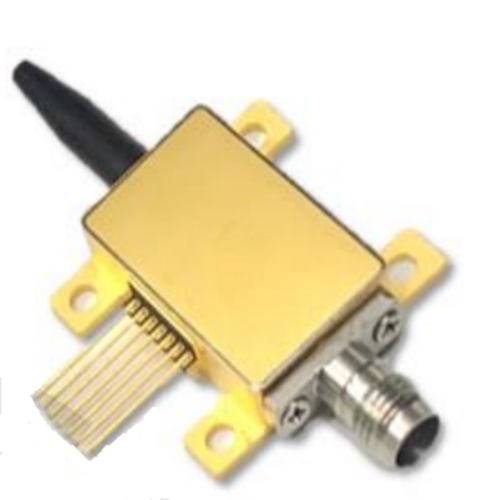
The ROF Thin film lithium niobate phase modulator is a kind of high performance electro-optical conversion device. The product is packaged by high precision coupling technology to achieve ultra-high electro-optical conversion efficiency. Compared with the traditional lithium niobate crystal modulator, this product has the characteristics of low half-wave voltage, high stability and small device size, and can be widely used in digital optical communication, microwave photonics, backbone communication networks and communication research projects.
|
Category
|
Argument
|
Sym |
Uni |
Aointer |
|
Optical performance
(@25C)
|
Operating wavelength (*)
|
|
nm |
1550 |
|
Optical return loss
|
ORL |
dB |
-27 |
|
Optical insertion loss (*)
|
IL |
dB |
MAX5.5
Typ4.5
|
|
Electrical properties (@25C)
|
3 dB electro-optical bandwidth (from 2 GHz
|
S21
|
GHz
|
X1:2 |
X1:4 |
| MIN18
Typ20
|
MIN36
Typ40
|
|
Rf half wave voltage (@50 kHz)
|
V |
V |
MAX3.5
Typ3.0
|
|
Rf return loss (2 GHz to 40 GHz)
|
S11 |
dB |
-10 |
|
Working condition
|
Operating temperature
|
TO |
C |
-2070 |
Advanced Thin Film Lithium Niobate ModulationHarnessing cutting-edge thin film fabrication technology, the modulator leverages lithium niobate (LiNbO3) for superior electro-optic phase modulation. Its design ensures high reliability and stability across challenging environments, contributing to efficient optical signal processing for high-frequency photonic systems.
Wide Compatibility and Ease of IntegrationFeaturing FC/APC optical connectors and K-type RF connectors, compatible with single-mode fibers, this modulator seamlessly integrates into contemporary photonics setups. Flexible power supply options, external DC input, and mounting versatility enable simple and efficient deployment in labs or systems.
Streamlined Performance for Demanding ApplicationsThis modulators broad optical bandwidth, low insertion loss, and high extinction ratio are ideal for microwave photonics, quantum optics, and advanced optical communications. Its robust build and high efficiency support reliable operation under a wide range of environmental and electrical conditions.
FAQs of Rof EOM modulator 20/40GHz Phase Modulator thin film lithium niobate Electro-Optic Modulator:
Q: How do I install and connect the Rof EOM phase modulator for my optical setup?
A: To install, securely mount the device on a benchtop or PCB using the provided accessories. Connect single-mode fiber (SMF-28 or equivalent) to the FC/APC port, and pair the K-type RF connectors with your high-frequency signal source. Ensure power is supplied via external DC at 5 V or 12 V as specified in the manual.
Q: What is the operating temperature range and how does it affect device performance?
A: The modulator operates efficiently between 0C and +70C, with stable phase modulation and low insertion loss. Storage temperature extends from -40C to +85C, providing durability in various environments. Operating outside specified ranges may compromise performance or device longevity.
Q: When should I choose the 20 GHz versus 40 GHz bandwidth option?
A: Select the 20 GHz bandwidth for moderate-frequency phase modulation in standard optical communication or radio-over-fiber applications. Opt for the 40 GHz version when high-frequency, ultra-fast modulation is required, such as in advanced microwave photonics or quantum optics experiments.
Q: Where is the Rof EOM modulator typically implemented?
A: This modulator is widely used in research labs, communication networks, quantum optics facilities, and microwave photonics systems. Its robust construction and hermetic sealing permit reliable use in demanding industrial and academic environments.
Q: What is the process for achieving high extinction ratio and low insertion loss in this device?
A: Thin film fabrication of lithium niobate, combined with AR coating and optical-grade surface finish, enables >20 dB extinction ratio and <3 dB insertion loss. Precise control of V (<4 V at 20 GHz) ensures efficient phase modulation and minimal signal degradation.
Q: How does using this phase modulator benefit my optical communication system?
A: Employing the Rof EOM modulator enhances signal integrity through high extinction ratio and low insertion loss, supports wide wavelength ranges, and improves overall system efficiency due to its high electro-optic response. Its reliable phase modulation allows for cutting-edge data transmission schemes.









 Send Inquiry


